Voters approved the $82M Pay-As-You-Go road plan with 63.8% on Nov. 3. About $30.9M goes to Mobile streets, including Dauphin Street and Michigan Avenue.
Updated Nov. 4: The program passed 70,890 to 40,299, or 63.76% for, in unofficial results from the Mobile County Probate Court with 79 of 80 precincts reported. See our full Mobile County results.
Mobile County voters will decide Tuesday, Nov. 3, whether to spend $82 million on 39 road and bridge projects. About $30.9 million of it would go to streets inside the city of Mobile.
The 2026 Pay-As-You-Go Transportation Improvement Program is the last item on the county ballot, under the heading “Special County Election.” The Mobile County Commission’s announcement said the program would improve 89.8 miles of roadway and six bridges.
The commission said the program needs no new taxes and no new debt. It is paid for by an existing 6.5-mill property tax that voters first approved in 1924. Since 1977 that money has been tied to road lists that voters approve every two years. This is the 21st list. Voters have approved all 20 before it, the commission said.
What Mobile would get
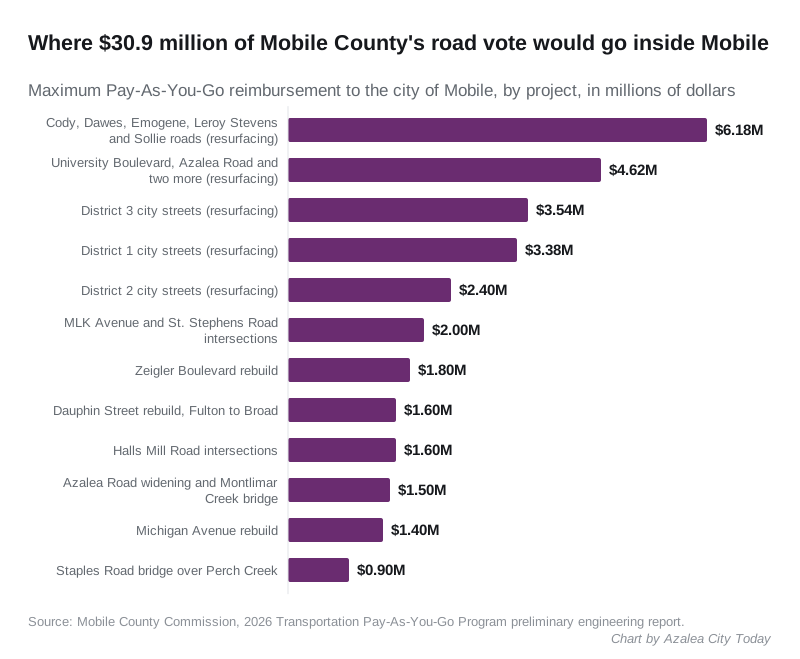
The figures below come from the county’s preliminary engineering report for the 2026 program. The city of Mobile’s own engineering department would design and build these projects. The county would pay the city back up to the amount listed.
Rebuilds, widening and intersections:
- Dauphin Street, rebuilt from Fulton Street to Broad Street, 2.1 miles: up to $1.6 million
- Michigan Avenue, rebuilt from I-10 to Government Street, 2.3 miles: up to $1.4 million
- Zeigler Boulevard, rebuilt from Cody Road North to Athey Road: up to $1.8 million
- Azalea Road, widened to five lanes from Halls Mill Road to near Rainbow Drive North, with a new bridge over Montlimar Creek: up to $1.5 million
- St. Stephens Road and Dr. Martin Luther King Jr. Avenue, intersection work at South Craft Highway and Dickens Avenue, plus a rebuild of St. Stephens Road from Gloria York Avenue to Wilson Avenue South: up to $2 million
- Halls Mill Road, intersection work at Satchel Paige Road and at the West I-65 Service Road: up to $1.6 million
- Staples Road bridge over Perch Creek, replaced with realigned approaches: up to $900,000
Resurfacing:
- Cody Road South, Dawes Road, Emogene Street, Leroy Stevens Road and Sollie Road, 10.7 miles: up to $6.18 million
- University Boulevard from Airport Boulevard to Moffett Road, Azalea Road from Halls Mill Road to Cottage Hill Road, plus parts of Lipscombs Landing and Lloyd Station Road, 6.5 miles: up to $4.62 million
- Old Shell Road from University Boulevard to I-65, with Dickens Ferry Road, Lakeside Drive and nearby streets, 6.6 miles: up to $2.4 million
- Neighborhood streets in commission District 1, mostly around Edwards Street, Green Street and Wiley Street, plus Howells Ferry Road from Schillinger Road North to Cody Road North, 9.6 miles: up to $3.38 million
- Neighborhood streets in commission District 3, including Bowers Lane, Old Military Road and the Bradbury and Campanella drives: up to $3.54 million
Those 12 lines add up to $30.92 million, or a little over a third of the program.
The rest of the county
The other $51 million or so goes to every other city and town in the county and to unincorporated areas. The commission’s announcement highlighted:
- intersection work at Celeste Road and Radcliff Road
- intersection work at Fowl River Road and State Route 193, with a new Fowl River Road bridge over Fowl River
- two new bridges on Beverly Jefferies Highway over the Escatawpa River
The commission said each of the county’s 11 municipalities has at least one project. That includes Chickasaw, about seven miles north, and Prichard, about eight miles north.
Why it takes years
Pay-As-You-Go projects usually take several years from the vote to the finished road, the commission said. Each one goes through survey, design, permits, land purchase, utility moves, bidding and construction. Many of the Mobile projects are listed as “partial matching funds,” which means the county money helps cover a bigger job paid for by the city or with state or federal money.
What it means for you
- You will not see a new tax line. The program uses money the existing 6.5-mill tax already raises. Our property taxes page explains how millage works in Mobile County.
- Find it on the ballot. It is the last item. You can check the Mobile County sample ballot before you go.
- Register by Monday. Monday, Oct. 19, is the last day to register or update your registration for this election. Our voting guide has polling places, ID rules and absentee deadlines.
- No orange barrels yet. Approval starts design work, not construction. We track live work on our road construction and closures page.
The full list of 39 projects, with maps for each, is in the county’s engineering report. Past programs back to 1977 are on the county’s Pay-As-You-Go page.
Have your say